The short version
- A decent uPVC door, fitted properly, should give you 20 to 30 years.
- The frame usually outlasts the parts that move: the lock, hinges, seals and glass unit.
- Most of those can be replaced without changing the whole door.
- Dark colours, rushed fitting and cheap hardware are what cut a door’s life short.
- Draughts, a misted unit, a door that drops or a lock that sticks are the signs to act on, and with winter coming it’s worth doing sooner rather than later.
Not sure about yours? Get in touch and we’ll give you a straight answer.
How long should a uPVC door last?
Most people ask this when something has gone wrong. The handle’s loose, the lock has gone stiff, or there’s a draught under the door that wasn’t there last winter. Fair enough, and the answer is better than you might expect.
Below we cover why uPVC suits homes around Coventry and Nuneaton, what goes into a good door, how fitting affects its life, what to look for as it ages, and what to do before the cold really arrives.
Why uPVC doors are so common around Coventry
Walk through Earlsdon, Chapelfields or any of the 1930s estates around the city and you’ll see the mix: semis, Victorian terraces, post-war family homes. A lot of them started life with timber front doors that swelled in a wet autumn and needed painting every few years. uPVC took over because it doesn’t rot, doesn’t warp the way timber can, and needs nothing more than a wipe with soapy water.
There are practical reasons too. It’s the most affordable way into a new door, it comes in far more styles than people expect, and it can be matched to the windows you already have. Multipoint locking is standard on ours, which matters on a street where the front door is the first thing anyone tries.
Our uPVC doors are supplied and fitted from our Nuneaton showroom, and we’ve been at it for over 25 years.
uPVC doors explained: specs, fitting and colour
Frame and glass
A multi-chamber uPVC frame, steel-reinforced where the door needs it. We work with Liniar profiles in chamfered (flat, modern) or sculptured (traditional). Glazing is a sealed double-glazed unit to BS EN 1279, clear or one of 25 obscured and decorative styles. Replacement doors need a U-value of 1.4 W/m²K or better under the Building Regulations, so check that figure on any quote.
Security
Look for multipoint locking and a TS 007 3-star cylinder (or SS312 Diamond), which is what most insurers expect. For the full picture, ask for PAS 24 or Secured by Design certification on the door itself.
Fitting
This is the part that decides how long the door lasts. The frame needs packing at the hinge and lock sides so it sits square without being squeezed, fixing into sound masonry, and a threshold and perimeter seal that keep water out. Get it wrong and the door drops or binds within a couple of winters. A replacement door also has to be notified under the Building Regulations, which a registered installer handles for you.
Colour
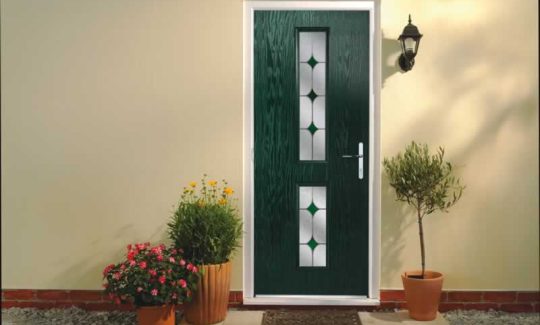
We offer 26 finishes, from whites, creams and greys like anthracite and agate to Chartwell green, burgundy and woodgrains such as golden oak and rosewood. Dark finishes soak up heat on a south-facing door, so think about which way your house faces before you commit. Cheaper white profiles can also yellow over the years, which comes down to how much UV protection is built into the material.
So how long do they actually last?
Most of the industry quotes 20 to 30 years for a uPVC door, and for a decent one that’s fitted properly we’d agree. Some do better. Some are tired at 15. Figures online run from 15 to 35 years, and you’ll notice they tend to depend on who’s selling. Some councils and housing associations plan to replace doors every 25 to 30 years, which is a more neutral yardstick. Our 10-year insurance-backed guarantee is a floor, not a forecast.
The frame is rarely what gives up. The parts that move take the wear: handles, locks, hinges, gaskets and the sealed glass unit. The good news is most of those can be swapped without touching the door itself.
What decides where your door lands in that range is mostly down to a handful of things. Profile quality and age matter, since UK-made profiles have been lead-free since around 2015. So does the fit, the quality of the hardware, how much sun the door gets, and how hard it’s used. A family front door that’s slammed eight times a day ages faster than a back door nobody uses. A bit of care helps as well: a wash with warm soapy water, a drop of silicone spray on the hinges and gaskets, and a look over the seals every few months.
Signs your door is wearing out
You don’t need any tools to check. Try these on a dry afternoon.
- Light test. Stand inside with the lights off in the evening and have someone shine a torch round the edge of the closed door. Any light showing means the seals aren’t doing their job.
- Paper test. Shut a strip of paper in the door at the hinge, lock and top. If it slides out without a fight, the gasket has gone flat.
- Handle and lock. The handle should lift and the door should lock with a gentle push. If you’re lifting hard, slamming it or fighting the key, the multipoint mechanism or hinges are on their way out.
- Dropping or catching. If the door scrapes the threshold or rubs at the top corner, the hinges may only need adjusting. If that doesn’t cure it, the frame or glazing packers have moved.
- Misting. Condensation trapped between the panes means the sealed unit has failed. It won’t clear on its own.
- The surface. Look for cracks, warping, chalky patches or a yellow tint, and for damp or staining around the threshold.
One fault is usually a repair. A lock, cylinder, handle or glass unit can be replaced for far less than a new door. Three or four faults on a door that’s past 20 years old, a warped frame, or hardware you can no longer buy parts for is when replacing makes more sense. And if your cylinder isn’t a 3-star anti-snap type, change that now whatever else you decide.
Why it matters before winter
A door is a big hole in a warm wall, and a worn one lets heat out every hour the heating is on. Failed seals, a door that doesn’t pull tight and a sagging frame all add up, and you feel it most on a cold November morning. A well-fitted modern uPVC door holds its heat, keeps the draughts out and stays warm to the touch. Frozen locks and doors that stick when the frame contracts are also far more common on tired doors than new ones.
A damaged door is a security problem too. A worn lock or an old cylinder is the weak point a burglar looks for, and some insurers will want a 3-star cylinder and multipoint locking before they’ll pay out.
If you’re worried about your uPVC door, send us a photo or give us a ring on 02476 350 330. We’ll tell you straight whether it needs a repair or a replacement, and if it’s a replacement, we’ll show you what’s on offer in our uPVC doors range. You can also contact us here to book a free quote.