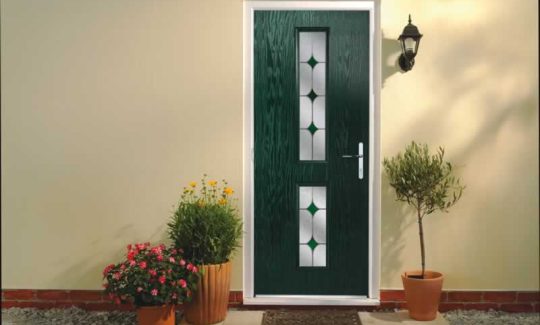
Most of the industry quotes 20 to 30 years for a uPVC door, and that is about right for a decent one fitted properly. You will find figures as low as 15 and as high as 35 depending on who you ask, which tells you what you probably already suspected. It depends far more on the individual door than on the material.
Ours come with a 10 year insurance backed guarantee, which is the period we will stand behind rather than the point the door gives up.
The frame outlasts the parts that move
This is the bit that catches people out.
uPVC is stable stuff. It does not rot, rust or take in water, and left alone it will sit in a wall for decades. What wears out is everything attached to it. Hinges, the multipoint lock, the weather seals, the glass units. A front door gets opened and shut a few thousand times a year, and every one of those cycles puts load through the same handful of components.
So when a 20 year old door starts playing up, the frame is rarely the problem. Whether that means a repair or a new door usually comes down to which parts have failed and whether they can still be sourced, and that is where the age starts to count. Hardware from the early 2000s can be difficult to match.
Signs your uPVC door needs replacing
You can feel the draught with the door shut
Weather seals go hard and flatten over the years. Once they have lost their spring they stop doing the job, and you get cold air tracking around the edge of a closed door or a hallway that never quite warms up in winter.
Seals on their own can often be replaced. If new seals do not fix it, the frame has usually dropped or distorted, and that is a different conversation.
You have to lift or lean on it to lock it
A door that needs a shove before the handle will lift is telling you the alignment has gone. Sometimes that is a hinge adjustment and half an hour’s work. Sometimes the sash has sagged far enough that no amount of adjusting brings it back square.
If you are forcing it, do not leave it. Eventually something in the lock mechanism gives, and that is when a door stops opening at all.
The glass has misted up
Condensation inside the sealed unit, the sort you cannot wipe away, means the seal around the glass has failed. The unit has stopped being double glazed and become two panes with damp air trapped between them.
In most cases that is a repair rather than a replacement. The glass unit comes out, a new one goes in, and the door carries on. Only replace the whole thing if other parts have gone as well.
The frame has discoloured or gone chalky
White uPVC yellows with sun exposure, and south facing doors get it worst. On its own that is cosmetic. What matters more is how the surface feels. Older uPVC can go chalky and brittle, and at that stage it will not take a repair well or clean up to look like new.
The lock is original to the door
Cylinders have moved on. If yours is the one that came with a door fitted in the 1990s or early 2000s, it predates the anti-snap standards insurers and locksmiths now expect. A replacement cylinder is not expensive and is worth doing whatever you decide about the rest of the door.
Repair it or replace it?
The rough rule we use when someone rings up: if it is one component and the rest of the door is sound, get it repaired. If three things have gone at once, or the frame itself has moved, you are better off replacing.
The other thing to weigh is what you gain. A door fitted 25 years ago is behind on insulation, behind on locking and probably behind on looks. If you are about to spend a few hundred pounds keeping it going, price up a new one first so you know what you are choosing between.
Why one door lasts longer than another
Quality of the profile matters. Installation matters more. A good door fitted badly will drop, stick and leak long before a modest one that was packed, fixed and sealed properly, and it is the least glamorous part of the job that decides how the next 20 years go.
Hardware is the other variable. Cheap hinges and locks are where a lot of budget doors save their money, and those are exactly the parts that take the wear.
Position plays a part too. A south facing front door in full sun and a sheltered side door under a canopy will age at noticeably different rates, on the same house.
Getting a few more years out of the one you have
There is not much to it.
Wash the frame down with warm soapy water two or three times a year and keep anything abrasive away from it. Put a drop of oil in the hinges and the lock keeps. Check the drainage slots along the bottom of the frame are clear, because blocked drainage leaves water sitting where it should not. And sort a stiff handle when it starts being stiff, rather than when it stops working altogether.
If it is time for a new one
We make our uPVC doors at our own factory on Attleborough Fields in Nuneaton and fit them with our own installers rather than subcontractors. Every one is made to measure, with a choice of chamfered or sculptured frames, 26 colours and finishes, and 25 obscured glass designs if it is a side door or a bathroom you want privacy on.
If you are weighing uPVC against a composite door, we make both, so ask and you will get a straight answer rather than a nudge towards the dearer one. Composite is generally quoted a longer life and costs more up front, and that is the actual trade you are deciding on.
Everything comes with a 10 year insurance backed guarantee. We are Assure registered, members of the Consumer Protection Association and rated 4.8 on Google from over 140 reviews, covering Nuneaton, Coventry, Hinckley, Rugby, Lutterworth and Tamworth.
View our uPVC doors or start your online quote. You can also call us on 02476 350 330.